CLASSIFICATION: GLOBAL SYNDICATETHREAT LEVEL 2DECRYPTED: 5/17/2026
Trump and Xi Settle Into a Rivalry Neither Side Can Afford to Break
VISUAL EVIDENCE
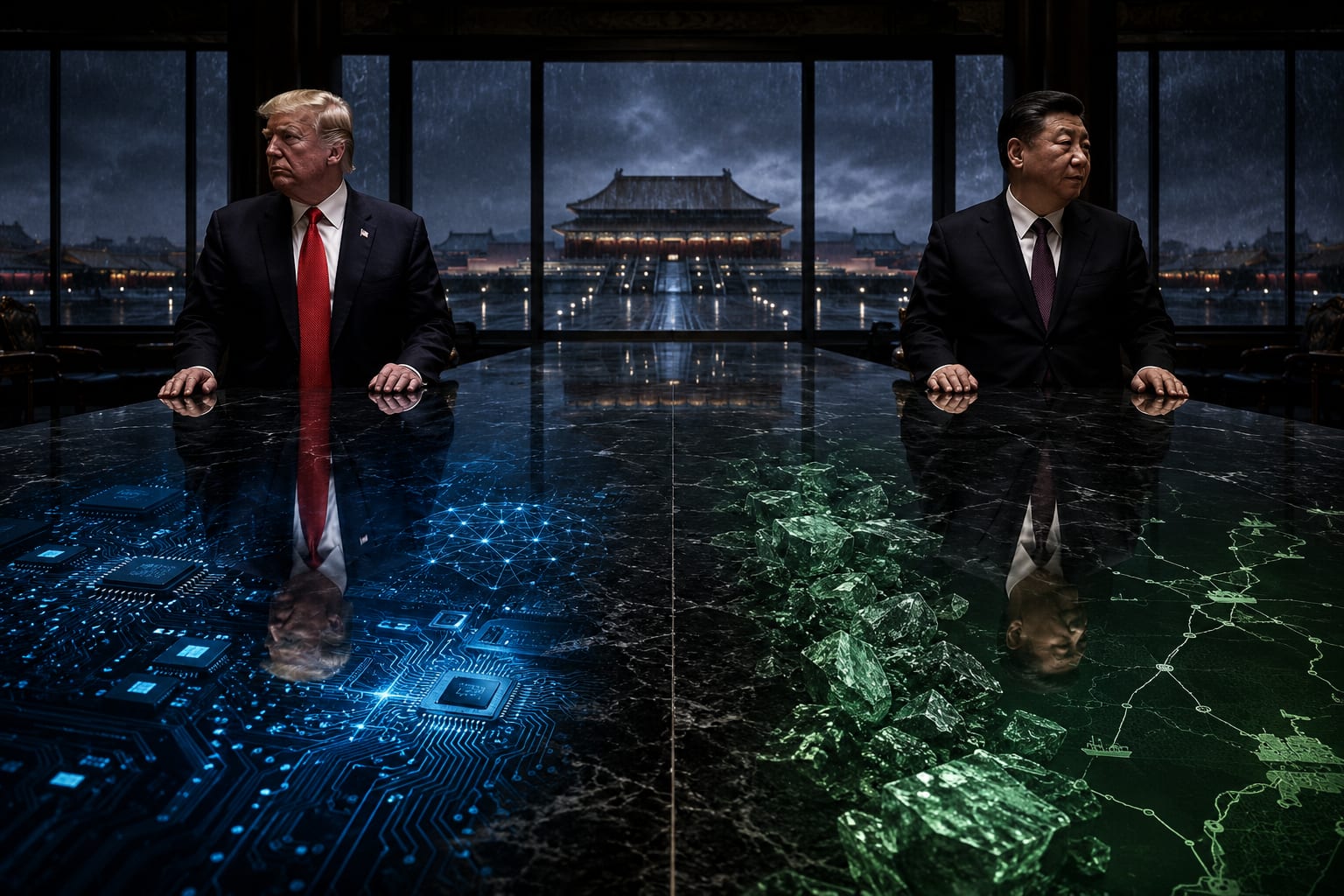
BEIJING — Donald Trump and Xi Jinping emerged from their latest summit in Beijing projecting stability, but the meeting also underscored how the U.S.–China relationship is increasingly being managed through containment of disputes rather than their resolution.
The Architecture of Containment
The talks covered a familiar set of pressure points: Taiwan, semiconductor restrictions, artificial intelligence exports, rare-earth supply chains, and shipping risks linked to Iranian oil flows through the Strait of Hormuz. In separate post-summit readouts, both governments emphasized the need for continued communication. China’s Foreign Ministry described the discussions as “constructive,” while the White House said the two sides agreed to maintain high-level economic and security contacts.Little changed publicly on the underlying disputes. According to China’s Foreign Ministry, Xi warned against “external interference” in Taiwan and reiterated Beijing’s opposition to any moves supporting formal independence. The White House avoided firm language on future U.S. military posture in the Indo-Pacific or additional arms transfers to Taipei, reflecting what several analysts described as an effort to keep deterrence intact without triggering a sharper escalation cycle.
[ VISUAL INTEL ] — In the briefing below, analysts and correspondents break down the "red lines" drawn by Beijing during the summit and the tactical deadlock over global infrastructure:
Weaponizing the Supply Chain
Trade and technology remained just as unsettled. U.S. export restrictions introduced through the Commerce Department over the past two years continue to limit China’s access to advanced AI chips and semiconductor manufacturing equipment, including systems tied to companies such as Nvidia and ASML. Beijing, meanwhile, has kept licensing controls on gallium, germanium, and several rare-earth materials critical to battery systems, missile guidance components, and data-center infrastructure.China still processes a large share of the world’s rare earth supply, leaving Western manufacturers exposed even as Washington pushes allied coordination on semiconductor controls through partnerships with Japan and the Netherlands.
That mix of commercial dependence and widening security competition has started to resemble a more fragmented form of power balancing than the U.S.–Soviet model that shaped the late Cold War. The comparison remains imperfect. The United States and China are still deeply tied through manufacturing, capital flows, and consumer markets, even as both governments build barriers around strategic technologies and energy infrastructure.
The Thucydides Trap
Researchers at the Center for Strategic and International Studies said the summit appeared focused less on settlement than on reducing the risk of miscalculation during a longer-term competition. Carnegie Endowment analysts made a similar assessment, describing the relationship as one increasingly defined by coexistence under pressure rather than stable cooperation.Xi also revived a phrase that has followed U.S.–China relations for more than a decade. According to Chinese state media transcripts from the summit, he referenced the “Thucydides Trap,” the idea popularized by Harvard scholar Graham Allison that rising and dominant powers can drift toward confrontation if rivalry outpaces diplomacy.
For now, the meetings continue, trade channels stay open, and the restrictions keep accumulating in parallel. Neither side appears ready to sever the relationship outright. Neither side looks prepared to settle the terms of it either.
----
Sources:
White House summit statement
China Ministry of Foreign Affairs
U.S. Commerce Department export control measures
CSIS analysis
Carnegie Endowment commentary