GRID COLLAPSE
3 RECORDS ACCESSED MATCHING DOMAIN DIRECTIVE
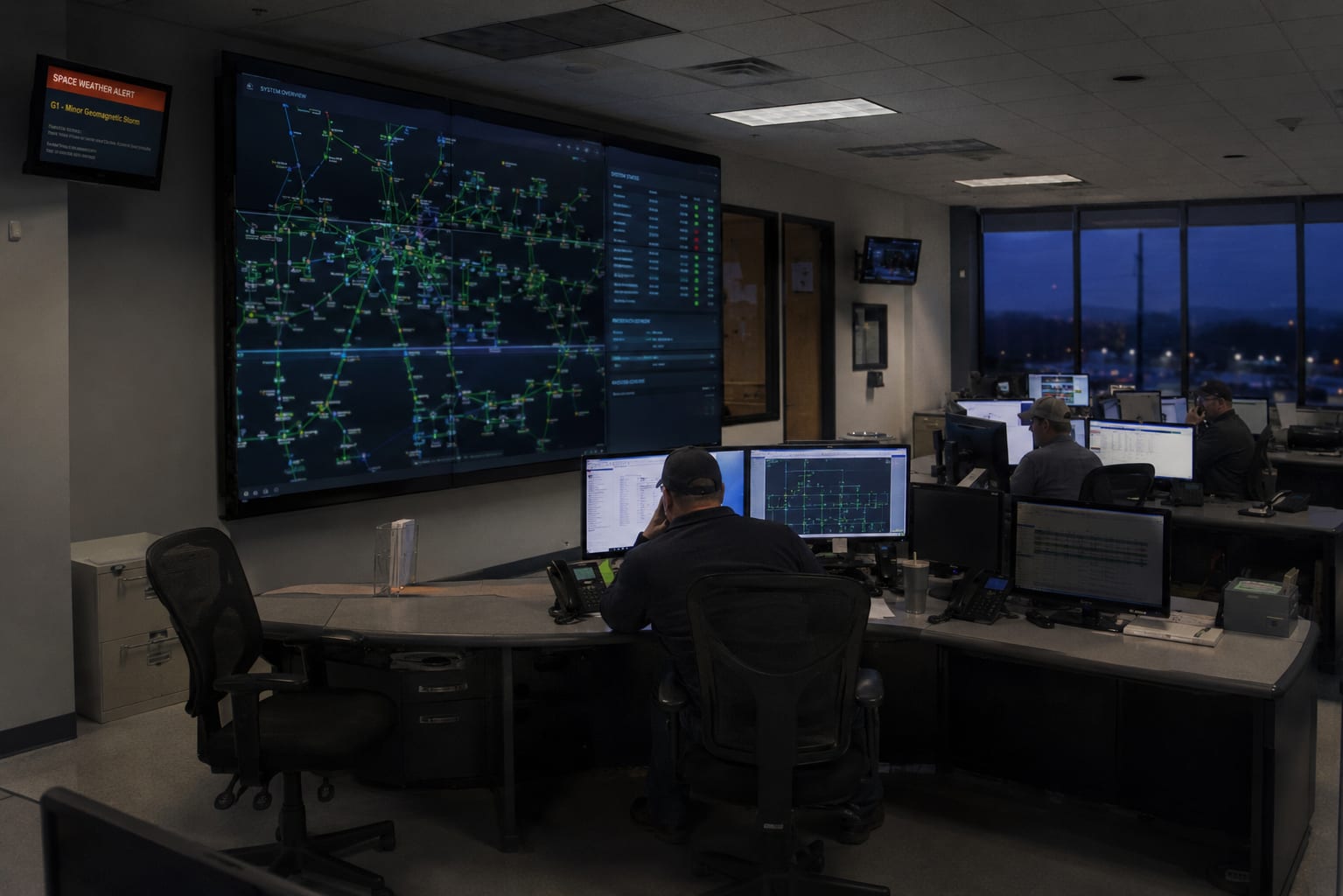
Solar Flares Renew Focus on the Systems Modern Life Depends On
BOULDER, CO — The latest burst of solar activity is drawing attention far beyond astronomy circles, not because scientists expect a catastrophic event, but because it highlights how much of daily life now depends on technology operating far above Earth's surface. An M9.3 solar flare erupted June 3 from Earth-facing sunspot region AR4455, with early indications that a coronal mass ejection, or CME, may be moving toward Earth. Hours later, the same active region produced an X1-class flare, underscoring the instability of a part of the Sun that researchers have been watching closely as solar activity remains elevated near the peak of Solar Cycle 25. According to monitoring updates from NOAA’s Space Weather Prediction Center, the main concern is not direct danger to people on the ground but the potential impact on technological systems that can be affected by geomagnetic storms. Satellites, high-frequency radio communications, GPS signals, and some power networks can experience disruptions when charged solar particles interact with Earth's magnetic field. The severity depends largely on the CME’s trajectory and magnetic orientation, factors that often remain uncertain until the solar material is much closer to Earth. A Growing Infrastructure Question The event arrives as governments, utilities, airlines, and satellite operators face a growing challenge: modern infrastructure has become increasingly dependent on systems vulnerable to space weather. Commercial aviation relies on navigation and communications links that can be degraded during major geomagnetic disturbances. Satellite constellations support everything from weather forecasting to financial transactions and logistics networks. Scientists have warned for months that the Sun is entering one of the most active periods of the current cycle. NASA and international space weather agencies have documented an increase in large sunspot groups and powerful eruptions as solar maximum approaches. Most events pass with limited consequences, but stronger storms remain possible while activity stays elevated. Watching the Days Ahead For now, researchers continue tracking the developing CME and assessing whether it could trigger significant geomagnetic effects later this week. Even if the current event produces only minor disruptions, it serves as another reminder that many of the systems underpinning modern economies depend on conditions that originate nearly 93 million miles away. The immediate threat may prove modest. The broader question—how resilient critical infrastructure would be during a much stronger Earth-directed solar storm—remains unanswered.
Massachusetts Fireball Exposes the Planetary Defense Gap Above Every City
BOSTON, Mass. — A bright meteor streaked across the skies of Massachusetts this week, producing a flash visible across multiple communities and reminding observers of a reality that modern civilization rarely confronts directly: Earth remains exposed to a natural threat that no government, military alliance or technology company can fully control. The object was relatively small. It burned through the atmosphere and caused no known damage. Yet events like this matter for reasons that go far beyond the individual rock itself. Every meteor entering Earth's atmosphere is evidence of a larger environment that operates beyond political borders and beyond human authority. Thousands of near-Earth objects cross the planet's orbital neighborhood every year. Most are harmless. Some are not. The challenge is not that scientists are unaware of the danger. NASA's Planetary Defense Coordination Office, international observatories and asteroid-tracking networks monitor thousands of objects capable of approaching Earth. The problem is scale. Space is vast, detection remains incomplete, and smaller bodies can still arrive with little warning. A System Built for Prediction, Not Prevention Modern planetary defense is strongest when threats are identified years in advance. Large asteroids with stable trajectories can often be tracked, modeled and monitored. NASA's DART mission demonstrated that humanity can alter the path of an asteroid under controlled conditions. But that success does not eliminate the broader vulnerability. Many smaller objects remain difficult to detect because of their size, speed, approach angle or position relative to the Sun. Some may only become visible shortly before atmospheric entry. That means the gap between discovery and impact can vary dramatically depending on the object involved. The Massachusetts meteor was harmless. The orbital environment that produced it is not. Civilization Lives Under an Open Sky The modern world depends on infrastructure that was never designed with cosmic hazards in mind. Power grids, telecommunications systems, satellite networks, transportation hubs and densely populated urban corridors all operate beneath the same atmosphere through which natural objects continue to arrive. Most days, nothing happens. Occasionally, a fireball appears over a city and briefly forces a different perspective. The event becomes a reminder that planetary defense is not a science-fiction concept or a distant academic exercise. It is an acknowledgement that human civilization exists inside a larger celestial system that remains only partially mapped and only partially understood. The meteor over Massachusetts did not create a crisis. What it revealed was something quieter: even in an age of artificial intelligence, nuclear deterrence and global surveillance networks, the planet still relies on a fragile combination of observation, probability and luck whenever something arrives from space. And eventually, one object will be larger than the last. ---- Sources: NASA Planetary Defense Coordination Office NASA DART Mission NASA CNEOS
Solar Maximum Finds the Same Weak Spot
BOULDER, CO. — The Sun’s peak is back in view, but the deeper risk is closer to the ground. As NASA and NOAA say Solar Cycle 25 has reached solar maximum, the real concern is not a single doomsday outage. It is that more of daily life now runs through the same thin layer of satellite links, GPS timing, radio signals and long transmission lines that space weather can hit at once. The Cascading Threat Vector NOAA’s Space Weather Prediction Center already treats that exposure as a set of operational problems: electric power transmission, GPS, high-frequency radio, satellite communications and satellite drag. On paper, those are separate systems. In practice, they overlap. A severe geomagnetic event does not have to destroy hardware across the board to cause trouble. It can knock timing off center, disrupt communications, force flight changes and pressure the grid in the same window. That is not theoretical. NOAA reported a rare S4 severe solar radiation storm in January 2026 and warned of risks to satellites, polar-route flights and high-frequency communications, while alerting the FAA, FEMA, NERC and other stakeholders. The point was not that everything would fail at once. It was that the same burst of solar activity could push several critical networks into protective modes at the same time. The Illusion of Grid Resilience Grid operators have at least built some of that risk into procedure. Under NERC reliability standards, reliability coordinators and transmission operators must maintain geomagnetic-disturbance operating plans for the interconnected transmission system. But those plans sit inside a much larger dependency chain that has grown more complex and less visible as more services chase speed, automation and tighter margins. NASA has already shown how quickly one part of that chain can slip. After a geomagnetic storm in February 2022, the agency said increased atmospheric drag contributed to the loss of 38 commercial satellites shortly after launch. After the May 2024 G5 storm, the FCC opened a formal comment process on communications impacts tied to the event, a sign that regulators were looking past spectacular aurora photos and into what the disturbance actually did to operating networks. Zero Margin for Error That is where solar maximum sharpens the story. The Sun does not need to “end” modern life to expose how much resilience has already been traded away. It only needs to jolt the shared layer beneath the grid, aviation, GPS-linked services and satellite networks long enough for the overlap to become impossible to ignore.